


Personal Productivity
Why Do We Leave a Meeting with More Questions than Answers?
AUTHOR: María Sáez
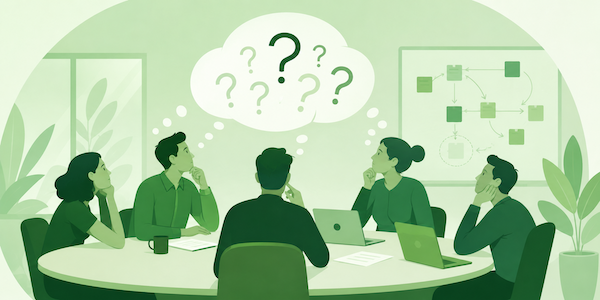
You leave the room or end the video call, and for a moment you feel like something has been resolved. There was a conversation, ideas were put on the table, and even a verbal agreement was reached. But twenty minutes later, as you’re already focused on another task, you still don’t feel entirely at ease: What exactly was decided? Who was responsible for what? And what did that comment about “we need to take our time” really mean?
Does this sound familiar? Meetings aren’t necessarily bad, but we often confuse two things that are similar but not the same: having discussed a problem and having solved it. And there’s a fairly specific explanation for that confusion; it has to do with how our minds work when switching from one activity to another.
The meeting doesn’t end when it seems to end
In 1982, researchers Doyle and Straus 1 first described what organizational psychology would later call meeting recovery syndrome: the time we need to “cool down” and regain our focus after a meeting, especially if it was confusing or poorly managed. It’s not simply fatigue. It’s that the brain doesn’t “wrap up” the meeting when the meeting ends.
Joseph Allen, an organizational psychologist who has studied this phenomenon extensively, says that switching from one task to another requires active cognitive effort. You have to “detach” from the previous task before you can focus on the next one. Under normal circumstances, that transition can take ten or fifteen minutes. But when a meeting hasn’t left a clear sense of closure—when it’s unclear what was decided or what happens next—that disengagement process can take up to forty-five minutes. During that time, even if you’re physically engaged in something else, part of your attention continues to process the previous meeting, trying to figure out a meaning it never quite had.
Steven Rogelberg, author of one of the most comprehensive studies on the science of meetings, points out that the problem is almost never the meeting itself. It’s meeting without it being clear, by the time it ends, what has actually changed outside that room. When a meeting ends without that clarity, it’s not just the time the meeting took that’s wasted. It also contaminates the time that follows.
Where are the decisions and commitments?
There’s a second, even more subtle problem that occurs even in meetings that do end with clear agreements. Someone says, “I’ll take care of that” or “I’ll send it to you this week,” everyone nods in agreement, and the conversation moves on. And that commitment, spoken aloud and seemingly accepted by everyone, fades away somewhere between the meeting room and the following Monday.
This problem has to do with prospective memory, a type of memory we use constantly and that often fails us. It’s not the memory that recalls what has already happened, but the one that has to remember to do something in the future. Early research in this field, such as that by Crovitz and Daniel in 1984 2, estimates that at least half of everyday forgetfulness doesn’t come from general memory failures, but specifically from failures of this type: we knew we had to do something, but when the time came to do it, that “reminder to remember” simply didn’t kick in.
Researcher Key Dismukes, who has studied these failures in high-risk contexts such as aviation, describes a mechanism that explains very well what happens once the meeting is over 3. When we’re focused on the task at hand, we become vulnerable to what he calls cognitive tunneling. We become so immersed in what we’re doing right now that we lose sight of the commitments we made an hour, a day, or a week ago, even though at the time they seemed obvious and impossible to forget. The commitment doesn’t disappear because we don’t care; it disappears because it never had a place outside our heads where it could survive the shift in attention.
The busier we are and the more complex the meetings are (the more people participate in a meeting, the greater the number of topics discussed, the quicker we jump to the next task), the more likely this is to happen. It’s not a problem of a lack of commitment or a poor memory. It’s a predictable characteristic of how human attention works under stress.
The problem isn’t the meeting
A meeting can be well-prepared, well-run, and full of good intentions, and yet still fall short in the most important way, because what really matters doesn’t happen during the meeting, but afterward. It happens the moment each person returns to their seat, and that verbal agreement has to survive the transition into the rest of their week.
This suggests that the question we usually ask ourselves, how can we make meetings more efficient?, may not be the most useful one. A more interesting question would be: What happens to the decisions made in the meeting as soon as the meeting ends? Is there a reliable place where they are documented, or do they depend entirely on each person remembering them on their own?
No meeting, no matter how well conducted, solves anything if the outcome doesn’t go beyond the minds of those sitting at the table.
1 Doyle, M., & Straus, D. (1982). How to Make Meetings Work. Jove. Cited in Rogelberg, S. G. et al., Less acting, more doing: How surface acting relates to perceived meeting effectiveness and other employee outcomes, DigitalCommons@UNO.
2 Crovitz, H. F., & Daniel, W. F. (1984). Measurements of everyday memory: Toward the prevention of forgetting Bulletin of the Psychonomic Society, 22(5), 413–414.
3 Dismukes, R. K. — research on prospective memory and “cognitive tunneling” summarized in Association for Psychological Science, When We Forget to Remember



No comments