


Personal Productivity
Why Do You Feel Anxious at Work Even When You Don’t Really Have Much to Do?
AUTHOR: María Sáez
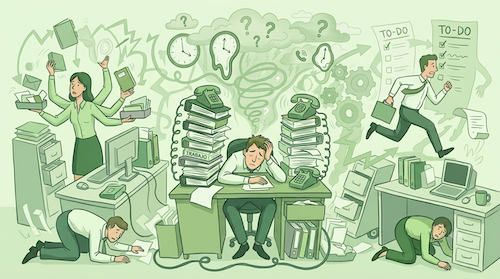
There’s a form of work-related anxiety that’s particularly unsettling because it doesn’t quite fit our understanding of stress. I’m not referring to the typical anxiety of an overwhelmed professional—someone with many ongoing projects, some of which are in crisis mode, and an inbox that just keeps growing.
Sometimes anxiety creeps in when, in theory, you have the situation under control, when there’s no active crisis and your workload is reasonable. Even so, something inside you remains on high alert, and your mind seems unable to fully relax. On Sunday afternoon, before the week begins, that shadow appears. You walk out of a meeting that went perfectly well, but you feel a vague unease that you can’t quite put your finger on.
If this sounds familiar, you’ve probably come to the conclusion that you’re the problem. That you’re too anxious, that you worry too much, and that you should learn to unwind. It’s an understandable reaction, but research points to something much more specific and, above all, much less personal.
The brain doesn’t distinguish between a tiger and an unanswered email
To understand why we feel anxiety without a proportionate, objective reason, it’s helpful to briefly review how the brain’s alarm system works 1. The amygdala, a subcortical region that has been evolving for millions of years, plays a central role in detecting threats and triggering the stress response before the rest of the brain has had time to analyze the situation. It’s an early-warning system designed for speed, not accuracy.
The problem is that the amygdala doesn’t properly assess the nature of the threat: it responds with the same urgency to a real physical danger as it does to uncertainty about whether a project is going well or if a message has been left unanswered. When the amygdala detects something ambiguous or unresolved, it activates the hypothalamic-pituitary-adrenal axis, triggering the release of cortisol and adrenaline, the same mechanisms that once helped us escape from a predator. Except that now there is no predator to run away from, and cortisol builds up with nowhere to go.
Studies have also shown 2 that elevated cortisol, in addition to preparing the body for a threat, increases the sensitivity of the amygdala itself and skews perception toward the negative, causing ambiguous situations to be interpreted as more threatening than they actually are. In other words, stress creates a greater predisposition to stress. It’s not weakness or hypersensitivity, it’s your nervous system doing exactly what it was designed to do.
Ambiguity as a source of chronic stress
Modern knowledge work has a characteristic that is rarely analyzed honestly: it’s structurally full of ambiguity. Not clear threats, but constant vagueness.
In the 1960s, psychologist Robert Kahn and his colleagues published one of the seminal studies on organizational stress 3, identifying two main sources of workplace stress that remain as relevant today as they were then. The first is role conflict: when a single employee faces incompatible demands from different people or parts of the organization. The second, and more subtle, is role ambiguity: a lack of clarity regarding exactly what one’s responsibilities are, how one is expected to act, or the criteria by which one’s work is evaluated. Kahn documented that this ambiguity is consistently associated with stress, anxiety, and reduced performance, regardless of the objective workload.
What is significant about this finding, confirmed by numerous subsequent studies, is that stress doesn’t require an excessive workload to arise. It only requires uncertainty. And in contemporary knowledge work, uncertainty is the default state: projects with vague success criteria, priorities that shift without anyone explicitly communicating them, commitments made in informal conversations that no one wrote down anywhere, expectations that are taken for granted without ever having been articulated. It’s not that the workload is excessive; it’s that it isn’t defined clearly enough for the brain to relax.
The cost of what remains unresolved
Added to this is a mechanism I already mentioned in the article on decision fatigue: the Zeigarnik effect and its impact on cognitive load. Unfinished tasks, unresolved commitments, conversations left hanging, issues on which no decision has yet been made—all of these remain active in the mind even when we aren’t consciously thinking about them. Not as a passive memory, but as a monitoring process that consumes mental resources in the background and keeps the alert system slightly activated.
Dugas and Freeston’s research on uncertainty intolerance 4 adds another layer to this picture. These researchers found that one of the most predictive variables of chronic worry isn’t the number of actual problems a person faces, but rather their ability to tolerate the fact that some things remain unresolved. For those with low tolerance for uncertainty, any ambiguous situation triggers rumination and worry as a coping strategy: if I think about this long enough, perhaps I can anticipate all possible scenarios and be prepared. It’s an illusion of control that comes at a very real cognitive and emotional cost.
Where does this anxiety come from, with no apparent cause?
Returning to the scene at the beginning: the vague tension of a Sunday afternoon, the unease that lingers after a meeting that apparently went well, the feeling that something is unresolved even though you can’t pinpoint what it is. These experiences don’t usually mean that you’re overly anxious or that you have a clinical problem. They usually indicate that your nervous system is responding rationally to a significant amount of ambiguity and unresolved issues that haven’t been processed, decided, or brought to a close.
To put it another way: the problem is rarely the amount of work. It’s the lack of clarity about that work. A professional with a heavy workload but complete clarity about what needs to be done, in what order, and what constitutes success experiences far less chronic stress than someone with a lighter workload but a list of vague commitments, blurred priorities, and pending decisions that never seem to get resolved.
Three principles suggested by current research
None of the findings above point to a magic solution, but they do converge on some fairly consistent ideas.
The first one is that reducing active ambiguity has a more direct impact on stress than reducing the workload. Even if the amount of work doesn’t change, there are many things that can help reduce the burden that your brain’s alert system keeps active in the background, such as clarifying what “done” means in a project, agreeing precisely on who is responsible for what, turning verbal commitments into something written and reviewable, and so on.
The second point, derived directly from the research by Masicampo and Baumeister that we mentioned in the previous article 5, is that it isn’t necessary to resolve an issue or complete it in order to close it out. It’s only necessary to have a reliable place where that issue is recorded, along with a decision about when or how it will be addressed. The mind stops monitoring what it perceives that it has been handled, even if it isn’t finished yet.
The third, perhaps the least intuitive, is realizing the difference between being busy and having clarity. Constant busyness can itself be a source of ambiguity: if you’re always reacting, there’s never any room to decide what deserves real attention and what doesn’t. The anxiety this creates doesn’t go away by working faster. It goes away, to a large extent, when the system surrounding your work (the decisions, commitments, and priorities) is structured enough so that your brain can finally let its guard down.
1 Davis, M., & Whalen, P. J. (2001). The amygdala: vigilance and emotion
2 Het, S. et al. (2017). Cortisol responses enhance negative valence perception for ambiguous stimuli. – Scientific Reports.
3 Kahn, R. L., Wolfe, D. M., Quinn, R. P., Snoek, J. D., & Rosenthal, R. A. (1964). Organizational stress: Studies in role conflict and ambiguity. John Wiley & Sons.
4 Dugas, M. J., Freeston, M. H., & Ladouceur, R. (1997). Intolerance of uncertainty and problem orientation in worry – Cognitive Therapy and Research, 21, 593–606.
5 Masicampo, E. J., & Baumeister, R. F. (2011). Consider it done! Plan making can eliminate the cognitive effects of unfulfilled goals – Journal of Personality and Social Psychology.


No comments