


Personal Productivity
Productivity Begins with Elimination, Not Addition
AUTHOR: María Sáez
Each new year arrives loaded with resolutions. Learn a new language, exercise more, read more books, develop a personal project… The list grows and grows, fueled by the excitement of becoming better versions of ourselves. But there’s a problem: our attention span and energy are limited, and as we continue to add commitments to our lives, we rarely stop to ask ourselves what we should eliminate.
The paradox of modern productivity is that, often, being more productive doesn’t mean doing more, but doing less. True personal productivity isn’t measured by the number of tasks completed, but by our ability to achieve maximum results with minimum effort. And that inevitably requires knowing how to say no.
The transformative power of purpose
Here’s the crux of the matter: how do you decide which activities to eliminate and which to keep? The answer isn’t found in time management techniques or more sophisticated productivity apps. It lies in something much more fundamental: having absolute clarity about your purpose.
When you know your purpose precisely, every decision becomes easier. Having a clear purpose consistently predicts how people do their work. It’s like having a lighthouse guiding you through the fog: it doesn’t remove the obstacles, but it clearly shows you the way forward. On the other hand, when there’s no clear purpose, motivation fades and cooperation with others deteriorates. We end up saying yes to everything, and every new opportunity feels as valid as the last.
A higher level of clarity enables people to progress. Not because they work extra hours or put in more effort, but because they focus their energy on what truly matters.
Your essential goal: the compass that changes everything
In his book Essentialism: The Disciplined Pursuit of Less, Greg McKeown introduces the concept of the essential goal as a personal alternative to traditional business definitions of vision and mission. An essential goal is unique: it is both motivational and concrete, both meaningful and measurable. It is not a vague aspiration such as “being happy” or “being successful,” but rather a clear statement that combines inspiration with specificity.
The most powerful thing about a well-defined essential goal is that it becomes a decision that lays the foundation for a thousand subsequent decisions. Think of it as an automatic filter for your life: every time a new opportunity, request, or temptation arises, you can instantly evaluate it against your core purpose. Does it bring you closer to it? Go for it. Does it distract you or keep you stuck? It’s time to say no.
This concept has a direct parallel with what David Allen describes in Getting Things Done: The Art of Stress-Free Productivity, referring to purpose as something that gives meaning and direction to your life. In the GTD methodology, purpose occupies the highest level of perspective, and from there, all other decisions become coherent.
The challenge of definition
Let’s be honest: defining your core purpose is no easy task. It’s not something you can do on a rainy afternoon over coffee. It requires asking difficult questions, the ones you’d rather avoid. What do I truly value? What impact do I want to have on the world? What am I willing to sacrifice to achieve it?
It also requires making real concessions. Accepting that you can’t have it all, that choosing one path means giving up others, no matter how attractive they may seem. And the hardest thing of all: applying real discipline to set aside those other “priorities” that constantly distract you from your true goal.
But here’s the reward: once you have clarity about your essential purpose, the noise dissipates. Decisions that once paralyzed you become obvious. The guilt of saying no disappears. And you discover that you have more time, more energy, and more mental space to focus on what genuinely matters.
Start the year by eliminating
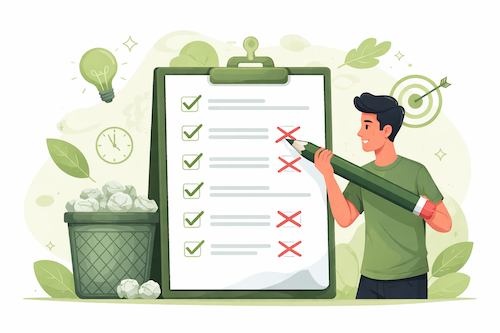
The beginning of the year is the perfect time to try a different exercise. Instead of adding more resolutions to your list, take the time to identify all the activities, commitments, and responsibilities that are not aligned with what you really want to achieve.
Review your calendar from the last few months. Go through your project lists. Be honest with yourself: how many of these things are bringing you closer to your main goal? How many do you do out of habit, social obligation, or simply because you once thought you should do them?
True productivity, the kind that leads to a more fulfilling life, begins with subtraction, not addition. Start by eliminating.

7 comments
This is a brilliant idea for the start of the year! And Happy New Year to you!
This is a brilliant idea for the start of the year! And Happy New Year to you!
Hi, Olga!
We're glad you find value in our work. Happy New Year to you too!
Hi, Olga!
We're glad you find value in our work. Happy New Year to you too!
Maria, you have really pinned down this issue and applied it to the new year with clarity that provides guidance to GTD aficionados. Facile Things is on the way to becoming the pre-eminent tool for GTD. It is a pity David Allen doesnt see fit to make you the official app because the other early contenders are running out of development focus. Happy New Year to you, Francisco, and the team behind development
Maria, you have really pinned down this issue and applied it to the new year with clarity that provides guidance to GTD aficionados. Facile Things is on the way to becoming the pre-eminent tool for GTD. It is a pity David Allen doesnt see fit to make you the official app because the other early contenders are running out of development focus. Happy New Year to you, Francisco, and the team behind development
PS
I should have added that your idea of eliminating/discarding really calls for something David Allen didnt think and GTD does not describe which is a "Resurrection Archive" where these discarded or eliminated tasks, projects, events are saved and stored in case circumstances or later reflection require them to be restored. The GTD workflow assumes that when you trash something, you have perfect judgement that it is never going to be required
PS
I should have added that your idea of eliminating/discarding really calls for something David Allen didnt think and GTD does not describe which is a "Resurrection Archive" where these discarded or eliminated tasks, projects, events are saved and stored in case circumstances or later reflection require them to be restored. The GTD workflow assumes that when you trash something, you have perfect judgement that it is never going to be required
Hi, Gary! Thanks for your support.
As far as I know, FacileThings is the only tool built directly on the GTD axioms. David Allen and his team attempted to translate the methodology into an app but were unsuccessful. Since then, they seem to view us more as competitors than as allies and have not been particularly welcoming or receptive to our project, nor interested in giving us a voice.
In any case, we are not trying to become the official GTD tool. We have run a campaign positioning ourselves as the most faithful software translation of GTD, which we genuinely believe we are, and that belief has been our guiding motivation throughout the app’s development. That said, just as software imposes unavoidable constraints, GTD itself also has certain limitations. We are not committed to preserving those limitations, but rather to offering newer and more flexible possibilities suited to the times—“betraying,” so to speak, the original approach when necessary.
As for your second comment, one advantage of the software version (FacileThings) is that deleted items are kept in the system for seven days. That may not seem like a long period, but it is also important to keep in mind that saying no means saying no—not “perhaps.” Determination in elimination is essential, since keeping everything perpetually open only leads to increased stress. Even if everything is, in theory, open to continuation, individual actions and projects must eventually reach closure. If an old issue becomes important again, it can simply be reintroduced into the system. In the meantime, however, the system should be kept as clean and streamlined as possible.
We’re always glad to be of help. Happy New Year to you too!
Hi, Gary! Thanks for your support.
As far as I know, FacileThings is the only tool built directly on the GTD axioms. David Allen and his team attempted to translate the methodology into an app but were unsuccessful. Since then, they seem to view us more as competitors than as allies and have not been particularly welcoming or receptive to our project, nor interested in giving us a voice.
In any case, we are not trying to become the official GTD tool. We have run a campaign positioning ourselves as the most faithful software translation of GTD, which we genuinely believe we are, and that belief has been our guiding motivation throughout the app’s development. That said, just as software imposes unavoidable constraints, GTD itself also has certain limitations. We are not committed to preserving those limitations, but rather to offering newer and more flexible possibilities suited to the times—“betraying,” so to speak, the original approach when necessary.
As for your second comment, one advantage of the software version (FacileThings) is that deleted items are kept in the system for seven days. That may not seem like a long period, but it is also important to keep in mind that saying no means saying no—not “perhaps.” Determination in elimination is essential, since keeping everything perpetually open only leads to increased stress. Even if everything is, in theory, open to continuation, individual actions and projects must eventually reach closure. If an old issue becomes important again, it can simply be reintroduced into the system. In the meantime, however, the system should be kept as clean and streamlined as possible.
We’re always glad to be of help. Happy New Year to you too!
Hi Maria
Thanks for taking time to reply
Have you approached GTD with an offer to write a software guide to Facile Things for them that they could put in their shop with their Outlook, Things, etc short manuals?
I agree that some expansion of GTD is required and it is disappointing that the revision of the GTD book by David Allen was, in my humble opinion, so very badly done. One sign is the internal repetition. Another is its failure to recognise habits or routines as a separate thing and how they need to get sandwiched into the day. (The health and wellness aspect of this is obvious). Another is its assumption that correct decisions are made on what to do with the thing. Another is his late recognition that context is not just one or two things (Place; People). On this point, I have raised with Francisco, the need to have at least five separate contexts: Place/Location, Presence (people), Tools/resources, Occasion, Weather. Weather is vital for people who work outdoors or people who use the outdoors for relaxation or spiritual comfort. These need to be separate categories not one list containing different types of context. But I dont think this is planned for FT. If it was implemented it would lead to a far cleaner user interface and quicker clarify because they become separate fields not multiple items in one field.
On resurrect-able tasks, I also disagree that 7 days is adequate. GTD forgot that the clarify process is followed by periodic review in addition to daily and weekly reviews. At a periodic review it can become apparent that something discarded in fact should be reinstated. This may not occur for some time. There should be "long term" resurrect-able tasks/projects/checklists/routines capability. SOme GTD apps have got around this by providing templates but this overlooks saving the intellectual labour that went into writing up an actual task etc. You say that "keeping everything perpetually open only leads to increased stress" but this is contradicted by having a someday/maybe category which you agree with. Resurrect-able tasks is just a refinement of this. I am sorry I cannot think of a better name but you get the idea
I look forward to seeing the new android beta because I have become convinced that the smartphone is the correct place to do GTD because it is some immediate not only for capture but the other workflows. Using my own version of GTD on my phone has changed my life. But for the reasons above I am not expecting FT Android beta to be the breakthrough I am hoping for. As other developers have found, doing the GTD list in the menu is easy but doing the detail screen of properties for a task is hard. DGT-GTD comes closest to a simple user interface for capturing task/project/checklist and an interface that is quick and easy for the clarify organise in the task detail screen. He is making some further changes so I have my eye on DGT-GTD too
Warm regards/gary
Hi Maria
Thanks for taking time to reply
Have you approached GTD with an offer to write a software guide to Facile Things for them that they could put in their shop with their Outlook, Things, etc short manuals?
I agree that some expansion of GTD is required and it is disappointing that the revision of the GTD book by David Allen was, in my humble opinion, so very badly done. One sign is the internal repetition. Another is its failure to recognise habits or routines as a separate thing and how they need to get sandwiched into the day. (The health and wellness aspect of this is obvious). Another is its assumption that correct decisions are made on what to do with the thing. Another is his late recognition that context is not just one or two things (Place; People). On this point, I have raised with Francisco, the need to have at least five separate contexts: Place/Location, Presence (people), Tools/resources, Occasion, Weather. Weather is vital for people who work outdoors or people who use the outdoors for relaxation or spiritual comfort. These need to be separate categories not one list containing different types of context. But I dont think this is planned for FT. If it was implemented it would lead to a far cleaner user interface and quicker clarify because they become separate fields not multiple items in one field.
On resurrect-able tasks, I also disagree that 7 days is adequate. GTD forgot that the clarify process is followed by periodic review in addition to daily and weekly reviews. At a periodic review it can become apparent that something discarded in fact should be reinstated. This may not occur for some time. There should be "long term" resurrect-able tasks/projects/checklists/routines capability. SOme GTD apps have got around this by providing templates but this overlooks saving the intellectual labour that went into writing up an actual task etc. You say that "keeping everything perpetually open only leads to increased stress" but this is contradicted by having a someday/maybe category which you agree with. Resurrect-able tasks is just a refinement of this. I am sorry I cannot think of a better name but you get the idea
I look forward to seeing the new android beta because I have become convinced that the smartphone is the correct place to do GTD because it is some immediate not only for capture but the other workflows. Using my own version of GTD on my phone has changed my life. But for the reasons above I am not expecting FT Android beta to be the breakthrough I am hoping for. As other developers have found, doing the GTD list in the menu is easy but doing the detail screen of properties for a task is hard. DGT-GTD comes closest to a simple user interface for capturing task/project/checklist and an interface that is quick and easy for the clarify organise in the task detail screen. He is making some further changes so I have my eye on DGT-GTD too
Warm regards/gary
Hi Gary,
We agree that the revised edition of David Allen’s GTD book was disappointing. Instead of clarifying previously introduced ambiguities, he made superficial, marketing-driven changes, such as renaming concepts.
We’re also very excited about the new Android beta, as it will allow us to deploy the full-featured version of the app on mobile devices.
Best regards,
María
Hi Gary,
We agree that the revised edition of David Allen’s GTD book was disappointing. Instead of clarifying previously introduced ambiguities, he made superficial, marketing-driven changes, such as renaming concepts.
We’re also very excited about the new Android beta, as it will allow us to deploy the full-featured version of the app on mobile devices.
Best regards,
María