

Personal Productivity
When Being Smart Isn't Enough: The Breaking Point That Changes Everything
AUTHOR: María Sáez
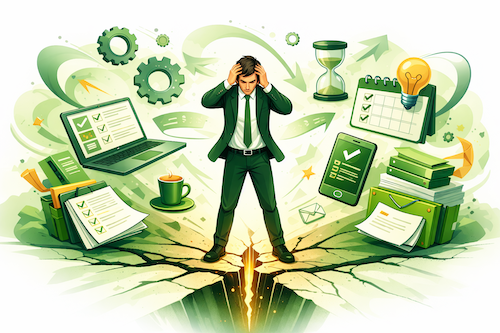
Sooner or later, all knowledge workers inevitably face a certain moment. It happens differently for everyone, but the conclusion is always the same: “I can’t keep all this in my head anymore.”
Maybe you notice it when you’re awake at 2 a.m., mentally reviewing everything you might be forgetting. Or when you promise a colleague you’ll send them something “first thing Monday morning” and then completely forget about it until Wednesday. Maybe it’s that uncomfortable feeling when someone asks, “Did you see my email?” and you realize it’s one of the 47 unread messages you’ve been trying to catch up on.
For my friend Sara, who is an architect, it was the moment she realized she was managing three different client projects, a business development proposal, her daughter’s school committee responsibilities, and a home renovation, all while her brain was frantically attempting to keep all her commitments in check: “I was drowning in a pile of unmanaged commitments; I was very disorganized.”
Areas of responsibility increase
This is what happens as your career progresses: the number of areas you’re responsible for multiplies, but your brain’s RAM remains exactly the same.
At the beginning of your career, you can juggle two or three main areas. Your job. Perhaps a personal project. The basics of your personal life. Your natural intelligence and memory are sufficient. You can keep the essentials in your head, and if something occasionally slips off your mind, the consequences are manageable.
But then life expands. You take on leadership responsibilities. Direct reports need things from you. You start a business. You have parents, elderly relatives. Your children have complex schedules. You need to be in several professional associations. You’d like to launch a podcast. Or maybe write a book.
Suddenly, you’re operating in five to seven important areas of your life simultaneously. Each of them involves multiple active projects. Each project involves quite a few activities. And your brain, which used to work so well, is now running background processes 24 hours a day, desperately trying not to let anything critical slip through the cracks.
Anxiety becomes constant. Mental overload is exhausting. And the paradox is that your intelligence actually makes it worse, because you can almost keep up with everything. Almost. So you keep trying, pushing harder, until something breaks.
False solutions
When you realize you need a system, the obvious move is to start using a personal productivity app. Any app. You try Todoist, Things, Omnifocus, Notion, ClickUp, Asana. You create to-do lists. You color-code them. You set due dates and reminders.
And within weeks, you’re drowning again, only now in a different way. Because here’s what you discover: a to-do list is not a system. It’s a grave where actions go to die.
Generic apps help you store information and organize it in some way, but they don’t give you a methodology. They don’t tell you:
- What to do with that vague idea that is “probably a project but could just be reference material”
- How to handle actions that can only be done in specific contexts
- When and how to review everything so that nothing gets stuck
- How to decide what to work on when you have two hours available
So you end up with 246 items in your “Inbox,” projects scattered across multiple lists with ambiguous descriptions and unclear boundaries, and that same nagging anxiety that something important is buried in there somewhere, invisible.
At this point, some decide to get more sophisticated: “I’ll build my own system,” they say. They create elaborate Notion setups or link multiple apps with automation tools. This works pretty well for about three weeks, until the maintenance burden becomes another source of stress. You’re no longer managing your work; you’re managing your productivity system.
Why a real system like GTD matters
When David Allen wrote Getting Things Done, he wasn’t describing a filing system or a new way of making lists. He was describing a complete cognitive algorithm for knowledge work, a systematic process for achieving what he called a mind like water.
The methodology has five steps, and what most people don’t see is that each of the steps is essential. You can’t just pick and choose the parts you like.
Capturing isn’t just about jotting things down; it’s about creating ubiquitous collection containers that your brain trusts completely. When you know you can capture anything, anywhere, your mind stops trying to hold on to everything.
Clarifying transforms vague ideas in your head into specific, actionable reality. Is it actionable? What’s the next physical step? Is it part of a larger project? This step is where chaos becomes clarity.
Organizing isn’t about folders and labels; it’s about creating a structure that reflects how you actually work. Context lists (calls to make, deep work in your office, errands outside) that show you everything you can do in your current situation. A calendar that is sacred. A Someday/Maybe list that keeps dreams alive without cluttering your action lists.
Reviewing is the step that everyone skips, and then they wonder why their system falls apart. The weekly review is where you process everything that came in, update the status of your projects, and get back on track.
Engaging is where you actually choose what to work on, trusting that your system has made visible everything that is relevant in this context, at this moment, with your current energy.
Only when you faithfully implement all five steps does something extraordinary happen. The underlying anxiety subsides. Mental overload decreases. You can truly focus on the task at hand because you’re no longer using half of your brain’s processing power trying to remember everything.
GTD users talk about “peace of mind,” feeling “more relaxed,” having “confidence that things are in the right place,” and experiencing genuine stress-free productivity.
The problem of implementation
But here’s the big problem: knowing GTD and doing GTD are two completely different things.
Reading the book gives you the knowledge, the algorithm. It doesn’t give you the implementation. That’s left as an exercise for the reader.
So you try to build it yourself. You set up contexts. You create project lists. You schedule weekly reviews. And then real life happens. Your carefully constructed system gradually deteriorates because maintaining it requires constant discipline and energy that you no longer have.
Or you try to use a general-purpose productivity app and bend it to GTD principles. You create “Calls” and “Computer” lists manually. You tag things with contexts. You set up filters and views. It sort of works, except you constantly have to remember how to use your own system. The tool isn’t guiding you through the methodology; it’s just giving you blank containers that you have to fill in correctly.
The implementation gap is real. Most people who try to implement GTD abandon it, not because the methodology doesn’t work, but because the friction of maintaining a customized system is too high.
A change of mindset is needed.
Transformation occurs when you stop trying to build the system and start using a system that embodies the entire methodology.
Imagine if capture were truly ubiquitous (email, mobile app, web), all flowing into a single inbox accessible on all your devices.
Imagine that the clarification process is guided, with the interface literally asking you the right questions: Is this actionable? What is the next action? Is there a project here?
Imagine contexts that organize themselves automatically, projects that track their own status, and a review process that is built into the system rather than something you have to remember to do.
Imagine committing to your work knowing that everything that can be done right now, in your current context, is visible. And that everything else is appropriately hidden until it becomes relevant.
When users talk about “peace of mind,” they’re not talking about some Zen state they achieved through willpower. They’re talking about what happens when you have a coherent external system that you trust completely. Your brain can finally stop trying to be your system, and just be your brain.
The identity change you need
The most significant changes aren’t about productivity metrics. They’re about identity.
“I really want to be a person who gets things done” isn’t a statement about doing more. It’s about moving away from being someone who is perpetually overwhelmed and reactive and becoming someone who is competent, organized, and in control.
Going from being a “serial procrastinator” to someone who reliably follows through on commitments doesn’t happen through motivation or discipline. It happens through infrastructure, by having a system that makes the right thing easy and the wrong thing hard.
The transformation from being “very disorganized” to having “confidence that things are in the right place” is achieved by rebuilding your relationship with your own commitments and capabilities.
The breaking point is a new beginning.
If you’re reading this and recognize yourself, if you’re at that point where being smart is no longer enough, where complexity has exceeded your brain’s ability to handle it, where anxiety is constant and you know something has to change, congratulations! You’re at the beginning of something promising.
It’s the moment when you stop trying to be your own system and start building (or adopting) systems that actually work. It’s when you stop feeling guilty about your “bad memory” or “lack of discipline” and start recognizing that knowledge work in the 21st century requires an external structure.
The chaos you’re experiencing isn’t a personal failure. It’s a natural consequence of trying to manage modern complexity with cognitive tools designed for a simpler time.
The way forward isn’t trying harder or finding the perfect app, nor is it building another custom system that you’ll abandon in six weeks.
It’s about faithfully implementing the complete methodology in a way that is sustainable, guided, and reliable, so that you can finally experience what “mind like water” really means.
And then getting back to the work that really matters.
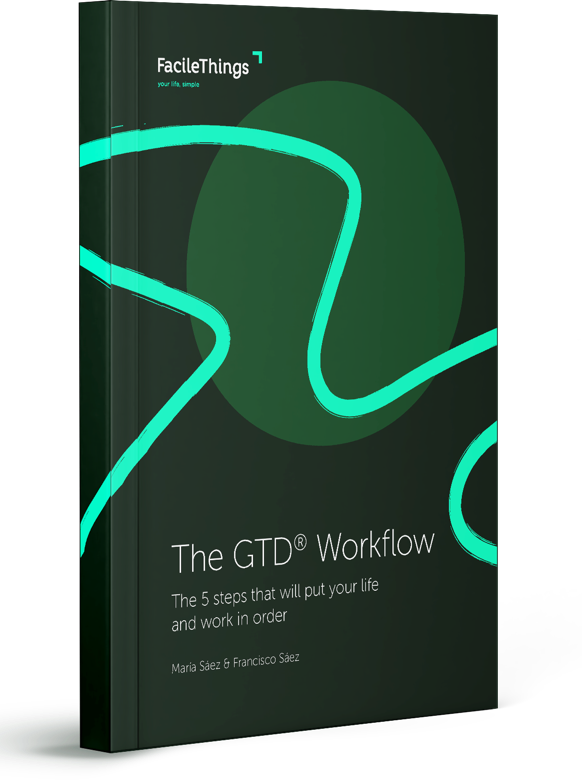
If you’re ready to experience a complete GTD implementation without spending months building and tweaking your own system, that’s exactly what FacileThings was designed for. It’s not a task app with GTD features. It’s the GTD methodology, fully implemented, guiding you through the five steps the way David Allen intended. Try it for 30 days and discover what “mind like water” really means.

4 comments
Thank you for writing this piece. It emphasizes a simple fact: you don't need a new app, you need a trusted system. When you have such a system you you just need an app that enables you to use it to the full. I'm happy FT is such a gem for GTD :)
Speaking of which, how is the progress going with the new app? Last update was… 2 months ago 😢
Thank you for writing this piece. It emphasizes a simple fact: you don't need a new app, you need a trusted system. When you have such a system you you just need an app that enables you to use it to the full. I'm happy FT is such a gem for GTD :)
Speaking of which, how is the progress going with the new app? Last update was… 2 months ago 😢
Hello, Michal. Thank you for your support.
You’ll be hearing news about the new app very soon—we’re publishing an update on Friday. I hope it will be helpful :)
Hello, Michal. Thank you for your support.
You’ll be hearing news about the new app very soon—we’re publishing an update on Friday. I hope it will be helpful :)
This post resonated with me and my experiences 100%. I feel like I've been caught out. As if someone had been watching me:
I've tried out a lot of apps in the last few months. Including niche apps like Timestripe and Akiflow, Atoms, and the many well-known ones. Every app has a strength that all the others lack. So I tried to compensate for the weaknesses with automation. But when it comes to peace of mind at the end of the day, regardless of a bird's-eye view of all my projects and areas of life, regardless of habit tracking and having a cool app on my watch, FacileThings, I have to say after reading your blog post, is absolutely number one!!
Wow!!!! A fantastic piece! Fascinatingly and captivatingly written.
Thank you so much @-->--
This post resonated with me and my experiences 100%. I feel like I've been caught out. As if someone had been watching me:
I've tried out a lot of apps in the last few months. Including niche apps like Timestripe and Akiflow, Atoms, and the many well-known ones. Every app has a strength that all the others lack. So I tried to compensate for the weaknesses with automation. But when it comes to peace of mind at the end of the day, regardless of a bird's-eye view of all my projects and areas of life, regardless of habit tracking and having a cool app on my watch, FacileThings, I have to say after reading your blog post, is absolutely number one!!
Wow!!!! A fantastic piece! Fascinatingly and captivatingly written.
Thank you so much @-->--
Hello, Gür! Thank you very much for the kind words.
FacileThings was developed to meet our own needs after a long period of dissatisfaction with existing apps and tools. We hoped that other people would find it as helpful as we do. We’re always glad to hear that this is the case.
Best regards,
María
Hello, Gür! Thank you very much for the kind words.
FacileThings was developed to meet our own needs after a long period of dissatisfaction with existing apps and tools. We hoped that other people would find it as helpful as we do. We’re always glad to hear that this is the case.
Best regards,
María