


Personal Productivity
You Can’t Kill Procrastination. You Can Only Replace It.
AUTHOR: María Sáez

The Golden Rule of Habit Transformation
In the mid-90s, neuroscientist Ann Graybiel and her team at MIT began tracking the electrical activity of the basal ganglia in rats as they learned to navigate a T-shaped maze. At first, the animals’ brains showed intense, widespread activity: they processed every decision, every turn, and every sensory signal with full attention. But as the route became familiar, something unexpected happened. Activity in the prefrontal cortex—the region associated with conscious thought and decision-making—gradually decreased. Instead, the basal ganglia, evolutionarily ancient subcortical structures, took control of the process with increasing efficiency. The brain had wrapped the routine into an autonomous module and executed it, literally, with its eyes closed. Graybiel called this process chunking: the conversion of a sequence of conscious actions into a single automated block, managed by structures operating below the threshold of consciousness. And the most interesting part of his findings was what happened when the maze changed: the old neural pattern didn’t disappear. It remained latent, ready to activate as soon as conditions resembled the original ones enough.
Charles Duhigg explores this idea in his book The Power of Habit (2012) and turns it into one of the most frequently cited theories in popular psychology: habits never disappear. Once the brain encodes a routine in the basal ganglia, that neurological imprint remains. It cannot be erased. It cannot be extinguished. It can only be replaced.
This is his so-called golden rule of habit transformation:
You can’t eliminate a bad habit; you can only change what it consists of. The cue and the reward remain. The routine is the only part that can be changed.
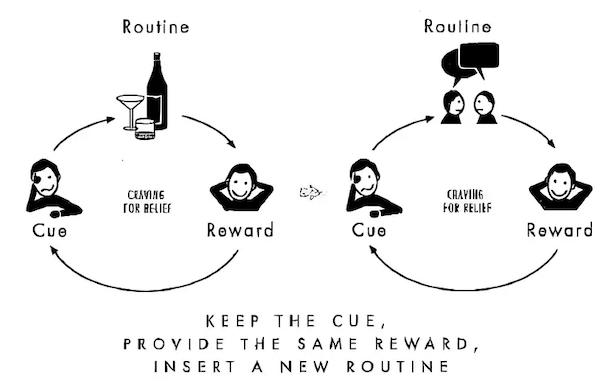
For decades, behavioral psychology had relied on extinction: if you stop reinforcing a behavior, it disappears. Duhigg argues that extinction is an illusion. What actually happens during “extinction” is not that the habit dies, but that it is temporarily suppressed by a stronger response. In moments of stress or low self-control, the old habit resurfaces with full force. This explains relapses into addictions, destructive behavior patterns, and… procrastination.
Procrastination isn’t laziness; it’s a structured habit
This is where many productivity approaches make their first mistake: treating procrastination as a character flaw, a matter of motivation, or worse yet, a lack of discipline. If that were the case, all it would take is a stronger will. But procrastination has the same structure as any well-established habit: a cue, a routine, and a reward.
The cue is usually a task perceived as threatening (boring, difficult, ambiguous, or associated with potential external judgment). The routine is the distraction: checking email, scrolling through social media, getting up for a coffee, tidying the desk. And the reward is the immediate relief from the tension caused by that pending task. The brain learns, repetition after repetition, that when that signal of discomfort appears, the distraction works. The tension eases. The reward system kicks in. The habit is reinforced.
Fuschia Sirois, a researcher at Durham University who specializes in procrastination, has pointed out in numerous studies that the key factor is not time management, but emotional regulation. Essentially, we procrastinate to escape a negative emotional state.
If Duhigg’s golden rule is correct, and there are good reasons to believe it is, then we can’t simply stop procrastinating. We need a technique that intervenes in the habit loop without trying to erase it. One that offers something better than the avoidance routine. This is where Habit Reversal Training comes in.
Habit Reversal Training (HRT): Origins and Mechanics
Nathan Azrin and R. Gregory Nunn developed Habit Reversal Training in 1973, originally to treat nervous tics, trichotillomania (the compulsive habit of pulling out one’s hair), and other repetitive behaviors. Their premise was radical for the time: instead of trying to suppress the problematic behavior, the patient would be trained to consciously replace it with an alternative response, one incompatible with the original habit but equally accessible the moment the cue appears.
HRT consists of several components that work in sequence. The first is awareness training: the patient learns to accurately identify the exact moment when the habit begins, the sensory or emotional cues that precede it, and the chain of micro-actions that make it up. You cannot interrupt what you cannot see. The second component is the development of a competing response: a physical or behavioral action that, by its very nature, cannot coexist with the habit routine. In the case of motor tics, this might involve clenching the hand muscles for one minute; for more complex behaviors, a more elaborate design is required. The third component includes motivation strategies and social support to sustain the change over time.
Subsequent studies have further solidified the evidence supporting the effectiveness of HRT, particularly in what is now known as Comprehensive Behavioral Treatment (ComB), an expanded version that combines HRT with other behavioral strategies. For disorders such as Tourette syndrome, HRT has become one of the first-line interventions recommended by most clinical guidelines.
But it took decades for the field of productivity to recognize its potential for non-clinical applications. If HRT could reshape habits as deeply ingrained as neurological tics, why not apply its reasoning to procrastination?
Applying the HRT to procrastination: a four-step process
Adapting the HRT to procrastination requires understanding that the behavior to be replaced is not a motor action, but rather a sequence of decisions that occur within a very brief period of time, often before the conscious mind has had a chance to intervene. The protocol, adapted from the original framework by Azrin and Nunn, can be structured into four steps.
Step 1: Mapping the Habit
The first step is to gain a deeper understanding of the habit until you uncover its true structure. This requires keeping a systematic record for at least a week. Every time you procrastinate, note down the trigger (what task was it? How did your body feel at that moment? What thought preceded the distraction?), the routine (what exactly did you do instead?), and the perceived reward (what sensation did the distraction produce?). Most people discover, to their surprise, that they procrastinate when faced with a very specific type of task and that the cues are much more physical and emotional than they realized: chest tightness, racing thoughts, a sense of helplessness.
Step 2: Training in awareness of the critical moment
The goal here is to reduce the latency between the signal and conscious detection. In the habit of procrastination, that interval is often so short that the person is already scrolling through social media before they have consciously decided to do so. The training involves practicing, in controlled, low-pressure situations, the recognition of the habit’s precursors: the specific sensation that precedes the impulse to avoid. Over time, this recognition occurs earlier, opening a window of opportunity where there was none before.
Step 3: Design the competitive response
The competing response must meet one essential condition: it must be incompatible with the avoidance routine, yet genuinely doable at the moment of greatest resistance. There’s no point in devising a heroic response (“I’ll start working right away with total focus”) if your emotional state at that moment makes that response unattainable. A more effective approach is to design what is called an ‘implementation intention’: a concrete, very small, and specific action that is carried out the moment the signal appears. ‘When I feel the urge to open my email to avoid this task, I will open the blank document and write only the title.’ The response is not to complete the task; it’s to initiate a small action that breaks the avoidance cycle.
Step 4: Motivation and reinforcement of the new loop
The original HRT includes a component of social support and motivation because Azrin and Nunn knew, from their early research, that changing habits requires sustained energy during a period when the new routine is not yet automatic and the old habit remains easier. In the context of procrastination, this can take the form of a visible tracking system for the number of times the competing response has been successfully applied, finding an accountability partner, or simply explicitly reflecting on the benefit gained each time the task was started despite resistance.
Strengths and Limitations of the HRT for Procrastination
HRT has several genuine advantages that set it apart from most common approaches to productivity. The first, and perhaps most important, is that it works with habits rather than against them. It doesn’t require constant willpower or a complete personality overhaul; instead, it calls for a surgical, one-step redesign of the usual loop. In that sense, it’s deeply consistent with behavioral change neuroscience.
The second advantage is its preventive approach. HRT intervenes before the habit is fully triggered, at the moment the cue appears, not afterward. Most productivity techniques intervene too late: when the person is already caught in the avoidance loop and needs willpower to break free. HRT aims to prevent the loop from starting in the first place, not to force a way out.
The third strength is its empirical foundation. Unlike many time-management techniques found in popular literature that lack substantial scientific backing, HRT is supported by decades of clinical research. Although most of that research focuses on repetitive clinical behaviors, the underlying mechanisms are similar enough for the transfer to the context of procrastination to be quite solid.
However, the HRT also has limitations that shouldn’t be ignored. The first is the complexity of its implementation. The full protocol requires a level of systematic self-observation that many people find difficult to maintain without external guidance. In clinical settings, the HRT is typically administered under the guidance of a therapist; when self-administered, the learning curve is considerable.
The second limitation is that HRT addresses avoidance behavior, but not necessarily the underlying causes of aversion towards certain tasks. If a task is avoided because it triggers a fear of failure, because it’s so ambiguous that the brain doesn’t know where to start, or because it’s disconnected from any meaningful purpose for the person, the competing response may prompt the start of the task, but the internal resistance will remain. HRT works best when combined with a review of the conditions that make certain tasks particularly unappealing.
The third limitation concerns the time it takes for results to become established. HRT doesn’t produce instant changes. Several studies on behavioral interventions for procrastination, such as those by Timothy Pychyl and Fuschia Sirois, suggest that it takes between four and twelve weeks of consistent practice for the new response to begin competing automatically with the old habit. For those looking for quick fixes, this can be frustrating.
The Long Game of Real Change
Duhigg’s golden rule encourages a different way of approaching the habits we want to change. Not as enemies to be eliminated, but as structures to be redesigned. This has both a positive and a negative side. The negative side is that no battle against a habit is ever truly won; the positive side is that change doesn’t require destroying anything, only building something stronger in its place.
Habit Reversal Training offers precisely that kind of approach. It doesn’t promise to turn procrastinators into productivity machines overnight. It promises something more modest and, at the same time, more sustainable: to teach the brain, with patience and precision, that there is another response available when the avoidance cue appears. And that this other response works, too.
In the vocabulary of the GTD methodology, this idea takes on a very specific practical dimension. The procedures for organization and workflow proposed by GTD (capture, clarify, organize, review, engage) aren’t just time-management techniques: they are systematic responses to specific cues. Every time an item enters the system, GTD offers a clear, predefined response. With time and consistent practice, these responses cease to require conscious effort and become automatic habits. And when the system of habits works in favor of productivity, procrastination doesn’t need to be fought directly: it simply ceases to have room to take hold.


2 comments
Excellent article yet again, María.
Facilethings really helps in this space, especially with its metrics and reporting (analytics). Something I hope is not lost in the next FacileThings iteration or its growing user base.
By using the metrics collected by FacileThings, I have successfully identified my peak energy times, understood which areas I tend to avoid, and pinpointed the best opportunities to achieve better results. While not part of the traditional Weekly Review, I have incorporated it using FacileThing's functionality to update my personal Weekly Review to evaluate my ongoing progress based on the data collected (especially the "Self-Assessment").
This is an area I feel that many so-called productivity applications get wrong, and where FacileThings gets it very, very right. FacileThings takes the long view, understanding that success is not so much a destination as a continuous journey that evolves over time. Procrastination, for me, is a clear sign of a lack of purpose. FacileThings gives me genuine and unabashed data that locks eyes with me and dares me to question it.
I love it. FacileThings has been a reliable partner through incredibly difficult personal and professional times and has helped me make positive, enriching changes in my life. Not to mention simply keeping me out of the proverbial ditch and keeping on the straight and narrow to finish strong.
I hope FacileThings - going forward - includes a way to track new habit-breaking and habit-forming goals and objectives. Perhaps a new item under the Analytics "Goals?"
Excellent article yet again, María.
Facilethings really helps in this space, especially with its metrics and reporting (analytics). Something I hope is not lost in the next FacileThings iteration or its growing user base.
By using the metrics collected by FacileThings, I have successfully identified my peak energy times, understood which areas I tend to avoid, and pinpointed the best opportunities to achieve better results. While not part of the traditional Weekly Review, I have incorporated it using FacileThing's functionality to update my personal Weekly Review to evaluate my ongoing progress based on the data collected (especially the "Self-Assessment").
This is an area I feel that many so-called productivity applications get wrong, and where FacileThings gets it very, very right. FacileThings takes the long view, understanding that success is not so much a destination as a continuous journey that evolves over time. Procrastination, for me, is a clear sign of a lack of purpose. FacileThings gives me genuine and unabashed data that locks eyes with me and dares me to question it.
I love it. FacileThings has been a reliable partner through incredibly difficult personal and professional times and has helped me make positive, enriching changes in my life. Not to mention simply keeping me out of the proverbial ditch and keeping on the straight and narrow to finish strong.
I hope FacileThings - going forward - includes a way to track new habit-breaking and habit-forming goals and objectives. Perhaps a new item under the Analytics "Goals?"
Thank you very much for your kind words, Cyrus.
Having someone appreciate our work like this is truly reassuring, as it shows that we are achieving our goal—at least for some users.
The Analytics tool will not be removed in future versions, but it will not be available immediately when we launch our next update. The beta version will initially include the core elements of GTD (the 5-step workflow, the lists, etc.), while features that go beyond the core methodology will be introduced later in subsequent updates.
As for the “habit-tracking” feature, it is part of our near-term roadmap. It will be available once the existing components have been fully updated in the latest version of the app.
Best regards,
María
Thank you very much for your kind words, Cyrus.
Having someone appreciate our work like this is truly reassuring, as it shows that we are achieving our goal—at least for some users.
The Analytics tool will not be removed in future versions, but it will not be available immediately when we launch our next update. The beta version will initially include the core elements of GTD (the 5-step workflow, the lists, etc.), while features that go beyond the core methodology will be introduced later in subsequent updates.
As for the “habit-tracking” feature, it is part of our near-term roadmap. It will be available once the existing components have been fully updated in the latest version of the app.
Best regards,
María